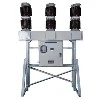
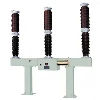
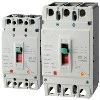
SF6 circuit breakers
1. Introduction
Vacuum circuit breakers and SF6 circuit breakers are the main components in switch cabinets. In Europe and most Middle Eastern countries, SF6 circuit breakers are preferred; in China, Japan, and the United States, vacuum circuit breakers are preferred; in other regions, the two technologies are almost equally popular. High-oil and low-oil technologies are still used in small quantities in China, Eastern Europe, India, and Latin America, but the trend is very obvious and will soon be replaced by SF6 circuit breakers and vacuum technologies. Relevant data show that multinational companies in the electrical industry, including ABB, are complementary in the development of the two technologies. In recent years, the latest and most important development of the two technologies at home and abroad is the use of permanent magnetic actuators and the integration of relevant sensor elements in the switch cabinet.
2 Arc interruption characteristics
2.1 SF6 circuit breakers
SF6 circuit breakers currently use self-blowing systems. The automatic blowing type circuit breaker has relatively small operating energy, but has good performance, such as small arc energy when cutting off short-circuit current and long electrical life; when breaking small inductive currents, its overvoltage multiple is less than 2.5 times. 2.2 Vacuum circuit breaker
The contacts of vacuum circuit breakers must have high resistance to arc corrosion when opening and closing; when breaking small currents, they should have low arc current performance. Research on materials shows that copper-chromium composite materials are the best and most satisfactory contact materials and copper-chromium composite materials with a chromium content of 20% to 60% are now used as standard materials for contacts. Initially, special contacts were used to prevent the radial magnetic field on the arc contact surface, forcing the arc root to rotate continuously along the contact surface, thereby preventing local overheating and uneven wear. A further improvement in the contact shape is the development of an axial magnetic field, which can evenly distribute the arc root over the entire contact surface.
3. SF6 circu
3.1 Permanent magnetic actuator
On the surface, the operating mechanism of the circuit breaker only realizes a simple "open-close" or "close-open" function. When the required position is reached, it is necessary to ensure that the contact remains in that position until a command to change the position is received. Therefore, the actuator is a typical bistable actuator, and its performance must be highly reliable. In the past, mechanical springs and cam mechanisms have been used for a long time.
The permanent magnetic actuator includes a fixed laminated core, permanent magnets, closing and opening coils, and special electronic devices, which can provide all electronic auxiliary functions such as interlocking, opening, closing, etc., and also includes self-diagnosis facilities. Electrolytic capacitors provide the impact power required for the opening and closing coils. The mechanical system of the permanent magnetic actuator is greatly simplified, and the large reduction in its components reduces the probability of failure accordingly, thereby reducing the maintenance level of the actuator[2]. The new vacuum and SF6 magnetic actuator circuit breakers are fully interchangeable with each other, just like the previous design. This interchangeability allows the existing switch cabinet to be re-equipped with minimal investment.
3.2 Integration of sensor elements and electronic devices
Using appropriate software and necessary current and voltage sensor elements, the protection function is integrated into the control system of the circuit breaker, making the circuit breaker a complete intelligent automation device with protection and switching functions, and achieving the highest reliability target, the least component interface, so as to facilitate the application in the medium-voltage secondary distribution system. This is also the current development status of the low-voltage distribution system.
4.Technical performance
4.1 Electrical and Mechanical Life
Usage experience shows that both vacuum circuit breakers and SF6 circuit breakers can be maintenance-free. High-quality SF6 circuit breakers and vacuum circuit breakers fully meet the standard requirements of Class B circuit breakers in IEC60056. That is to say, Class B circuit breakers do not require maintenance on the break components within the expected life, but only require maintenance on other components. IEC stipulates the number of operations that the circuit breaker should be able to complete based on the use conditions such as the exhaust line network connected to the circuit breaker and whether the reclosing switch is used.
4.2 Operation overvoltage
SF6 circuit breakers have a low operation overvoltage level without any external devices.
5. Application Examples
(1) Exhaust lines and cables: When used to cut off and protect the exhaust line distribution network, both vacuum and SF6 circuit breakers meet the requirements.
(2) Transformers: Modern vacuum circuit breakers and SF6 circuit breakers are suitable for cutting off the excitation current of unloaded transformers with an overvoltage multiple of less than 3.0.
In some special cases, such as when vacuum circuit breakers are used to cut off dry-type transformers in industrial equipment, lightning arresters are recommended.
(3) Motors: When circuit breakers are used to cut off motors, full attention must be paid to the issue of handling overvoltage. The target limit of overvoltage is less than 2.5 times, which can be achieved by both circuit breakers. When vacuum circuit breakers are used to cut off small motors (starting current less than 600A), measures to limit overvoltage may be required due to multiple reignitions of the arc, which is a very low probability phenomenon.
(4) Capacitor banks: Both technologies are applicable to capacitor bank switching without reignition. When switching in groups, reactors may need to be installed to limit the impact current. Synchronous control technology of circuit breakers is an effective solution to this problem. SF6 circuit breakers are particularly recommended for applications with rated voltages above 27kV.
(5) Arc furnaces: Switching of arc furnaces is characterized by frequent operation, high current, and short intervals. Vacuum circuit breakers are particularly suitable for such applications.
(6) Shunt reactors: SF6 circuit breakers are suitable for switching shunt reactors, which usually have an overvoltage multiple of less than 2.5. Additional measures to limit overvoltage may be required when using vacuum circuit breakers.
(7) Electrified railway traction: In principle, both circuit breakers can be used, but in some low-frequency power supply applications (such as 16.67Hz), vacuum circuit breakers are recommended.
6. Conclusion
From the point of view of use, SF6 circuit breakers and vacuum circuit breakers are complementary technologies. Economic factors, user preferences, habits in the country, manufacturing capabilities, and special switching requirements are the main factors for decision-makers when determining the type of circuit breaker. Special requirements such as matching the circuit breaker with the working conditions and frequent switching may be additional factors affecting the selection of the circuit breaker type. At this time, a comprehensive study may be needed to make the best choice.
SF6 circuit breakers, we are well aware of the importance and are committed to providing customers with high-quality products and services. For more information, please feel free to contact us.
Email: jasmine@yawei-electric.com
WhatsApp: +86 13584708127